What if our cognitive declines were starting at night?

Sleep: that invisible pillar shielding our brain
What if certain cognitive difficulties did not originate in the brain itself… but in how it recovers?
In our modern societies, sleep is often viewed as a simple resting period, a pause in brain activity. Yet, recent research shows that it constitutes one of the fundamental mechanisms through which the nervous system regenerates, reorganises and maintains its balance.
Through the close links between sleep, emotional regulation and cognitive functioning, an idea is gradually taking hold: the brain never operates in isolation. It permanently depends on the physiological state of the body carrying it.
Understanding attention, memory or mental fatigue problems might then require us to shift our gaze: before seeking to stimulate cognition, it may be necessary to restore the biological conditions that allow the living system to recover.

Listen to the audio version of this article
Introduction — What if our cognitive disorders started at night?
When the first cognitive difficulties appear — less reliable memory, fluctuating concentration, mental fatigue — the most frequent reaction is to search for an explanation directly in the brain.
We think of age.
We think of stress.
We sometimes think of a neurological disease.
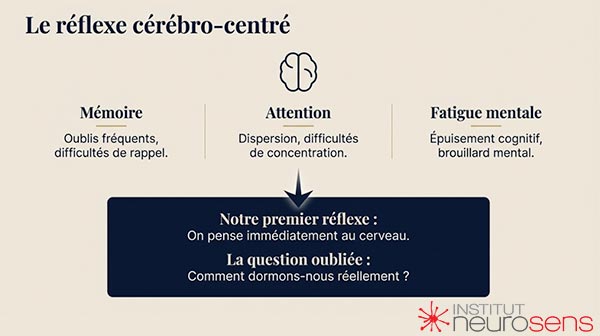
But a much simpler question is rarely asked:
How are we actually sleeping?
What science says
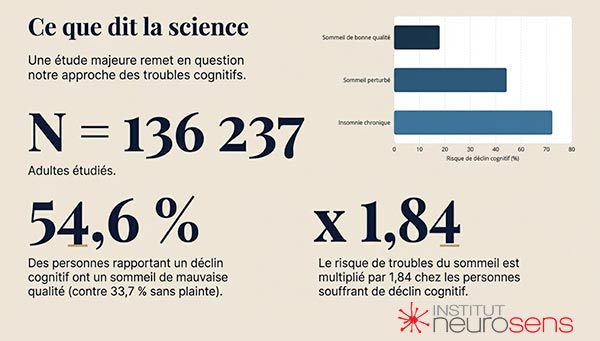
A population study of 136,237 adults aged 45 and over examined the link between sleep quality and subjective cognitive decline, which is the progressive feeling of memory loss or mental clarity (Kim & Kim, 2025).
The results show a clear association between these two dimensions:
• 38.6% of participants present poor quality sleep.
• 23.5% report subjective cognitive decline.
• Among those reporting cognitive decline, 54.6% declare poor quality sleep, compared with 33.7% in those with no cognitive complaint.
After taking demographic, social, and medical factors into account, individuals reporting cognitive decline present an approximately 1.8-fold higher risk of suffering from poor quality sleep.
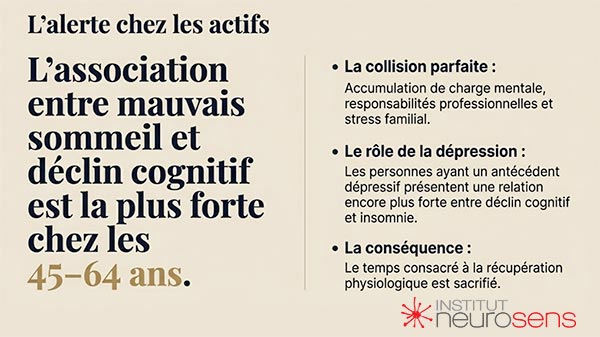
The association appears particularly strong in middle-aged adults (45–64 years) and in people presenting depressive symptoms.
These findings reinforce the idea that sleep quality is a key factor in cognitive and emotional balance throughout life.
These findings reinforce an idea increasingly recognised by research: sleep quality is a central factor in cognitive and emotional balance throughout life.
But above all, they invite us to ask a more fundamental question.
What if, in many cases, the problem did not stem solely from cognition… but from brain recovery?
Sleep: a biological function far more complex than we think
In modern life, sleep is often treated as an adjustable variable. We sleep less to work more, to finish a project, or to meet the demands of daily life. Yet, from a neurobiological perspective, sleep plays several essential roles. Firstly, it participates in the restoration of physical and mental functions. During the night, brain activity does not stop; it simply changes nature. The brain then enters specific phases that allow the consolidation of learning, emotional regulation, and physiological recovery.
A major discovery in recent years has particularly caught researchers' attention.
During certain phases of sleep, the brain activates a waste clearance system known as the glymphatic system. This mechanism removes proteins and metabolic waste that accumulate in brain tissue during the day. When this process is disrupted, these substances can gradually build up and contribute to brain ageing.
Several studies also suggest that poor sleep quality is associated with structural brain changes, including an acceleration of cortical atrophy in certain regions involved in memory and cognitive functions (Sexton et al., 2014).
In other words, sleeping well is one of the necessary biological conditions for brain health.
When sleep weakens, cognition falters
The Korean study highlights an interesting phenomenon: the relationship between sleep and cognition seems bidirectional.
Poor sleep can impair cognitive performance, but cognitive concerns can also disrupt sleep.
Several mechanisms can explain this interaction.
Firstly, certain brain changes associated with ageing or inflammation can affect both memory circuits and the structures involved in sleep regulation.
Secondly, chronic stress plays a major role.
When the body remains in a prolonged state of alert, the hypothalamic-pituitary-adrenal axis — often called the HPA axis — remains activated. This physiological activation increases the level of arousal and makes falling asleep harder, whilst disrupting nightly recovery cycles.
Finally, a well-known psychological phenomenon can play a role: mental rumination.
When worry about cognitive abilities arises, it can intensify at bedtime. Attention turns to thoughts and anticipated scenarios, which increases brain activation and reduces sleep quality.
We then see a vicious circle emerge:
fatigue → worry → disrupted sleep → impaired cognition → heightened worry.
A particularly strong signal in middle-aged adults
One of the most surprising results of the study concerns age.
Contrary to what one might imagine, the association between poor sleep and cognitive decline appears stronger in middle-aged adults, between 45 and 64 years old, than in older individuals.
Why?
Researchers propose several hypotheses.
At this stage of life, professional, family, and social demands are often high. Responsibilities are numerous: work, household management, supporting children or ageing parents. This accumulation of pressures can increase stress and reduce the time dedicated to recovery.
Moreover, active adults are often particularly sensitive to the slightest drop in cognitive performance, as this can have direct consequences on their professional activity.
Sleep then becomes a valuable indicator of the overall level of regulation of the nervous system.
The amplifying role of depression
The study also highlights another important factor: depression.
Individuals who have experienced a depressive episode present an even stronger relationship between subjective cognitive decline and poor sleep quality.
This phenomenon is not surprising.
Depression is associated with several biological disruptions that directly affect sleep:
• alteration of circadian rhythms
• increased physiological activation
• modification of deep sleep and REM sleep cycles.
Several studies indeed show that improving sleep quality can lead to a significant improvement in mental health, particularly by reducing symptoms of depression, anxiety and stress (Scott et al., 2021).
Furthermore, depressive states alter the subjective perception of cognitive performance. Affected individuals may prove particularly attentive to mistakes, forgetfulness or concentration difficulties.
Sleep, cognition and mood thus form a closely interconnected triangle.
An often forgotten perspective: the body and physiological regulation
In most traditional approaches, cognitive disorders are studied primarily through the brain itself: brain imaging, biomarkers, neuropsychological tests.
These tools are valuable, but they can sometimes give the impression that cognition is an isolated function.
Yet, the brain never works alone.
It constantly depends on the physiological state of the body carrying it.
Breathing, postural tone, emotional regulation and sleep quality are all mechanisms directly influencing brain activity.
From this perspective, sleep must not be viewed as a mere secondary symptom. Rather, it acts as a central regulator of neurophysiological functioning.
When sleep deteriorates, it can signal that the system's global balance is weakening.
Fundamental
Sleep: a pillar of the neuro-integrated system
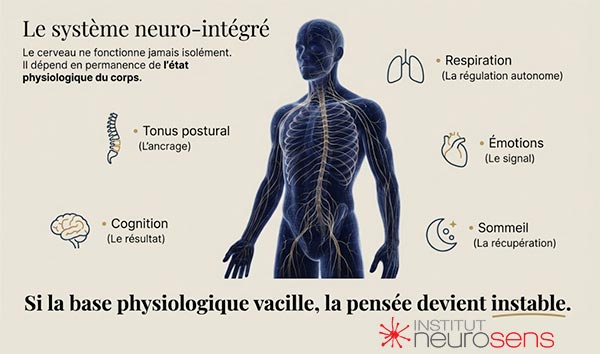
In the Integrative Neurotherapy approach, sleep is not considered a mere state of rest. It constitutes one of the pillars of the neuro-integrated system linking the brain to the living body.
This system relies on several closely synchronised fundamental functions:
postural tone, breathing, sleep, emotions and cognitive functions.
At the heart of this organisation lies the Tonic-Ventilatory System (STV), a regulatory network that constantly coordinates the balance between posture, ventilation and brain alertness.
In this dynamic, sleep plays an essential role:
• it allows the neurophysiological recovery of the brain
• it supports the consolidation of learning and memory
• it participates in emotional regulation
• it promotes brain metabolic waste clearance processes
When sleep weakens, it is not just the night that is disrupted.
It is often the entire balance of the neuro-integrated system that becomes deregulated.
Attention difficulties, mental fatigue, emotional instability, or certain cognitive complaints can then appear as the visible signs of insufficient recovery of the nervous system.
From this perspective, improving sleep quality is not just about 'sleeping better'.
It is above all about restoring the regulation capacity of the brain-body system.
Sleep then appears in a new light. It does not just constitute one biological function among others, but one of the mechanisms by which the body recovers its deep balance.
Understanding cognitive disorders perhaps requires, above all else, understanding how the living system recovers.
In the perspective of the tonic-ventilatory system, the various pillars of adaptive functioning — tone, breathing, sleep, emotions and cognition — do not function separately. They influence each other constantly and synchronise through shared physiological rhythms.
The night plays a special role here.
When the conditions for recovery are met, brain rhythms reorganise, autonomic systems recalibrate, and emotional circuits regain stability. The entire living system gradually retunes itself.
Sleep is therefore not just a pillar: it is one of the moments when the STV retunes the entire living system.
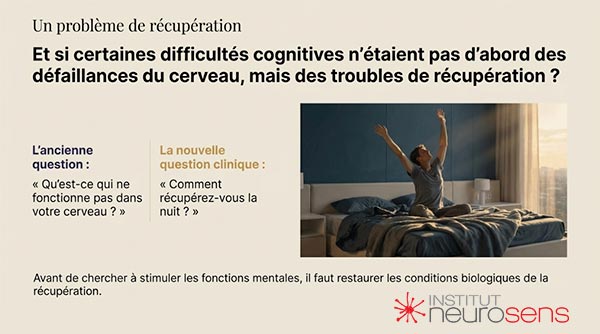
Understanding this profoundly changes the way cognitive disorders are approached. Before seeking to stimulate mental functions, it may be necessary to restore the physiological conditions that allow the nervous system to recover.
Rethinking cognitive disorders through the lens of recovery
This vision opens up an interesting line of thought.
Rather than immediately viewing cognitive difficulties as a purely brain-related problem, it may be useful to ask a more fundamental question:
is the nervous system recovering sufficiently?
In many cases, cognitive fatigue is not simply linked to a lack of capacity, but to insufficient physiological recovery.
Sleep plays a decisive role here.
When nightly recovery cycles are disrupted — by stress, sleep-related breathing disorders, emotional hyper-arousal or other factors — the brain operates in a sort of energy-saving mode.
Concentration decreases.
Memory becomes less reliable.
Emotional regulation weakens.
This picture can sometimes resemble a primary cognitive disorder, when it is primarily an imbalance in physiological regulation.
Case Study
A shift in perspective
Marie seeks clinical advice at age 52 for memory difficulties. She explains that she forgets certain details more often, reads the same messages multiple times and feels mentally less sharp.
Her first worry is immediate:
“Is my brain starting to decline?”
But in an attentive clinical approach, the complaint is never considered an isolated event.
The interview then traces back her life trajectory.
For several years, her sleep has become unstable. Night-time awakenings are increasing, days begin with persistent fatigue, and evenings drag on late in front of a screen to “unwind”.
At the same time, professional responsibilities have intensified and the mental load has gradually increased.
Nothing spectacular.
Nothing sudden.
But a set of small changes that, over time, have weakened physiological recovery.
The cognitive complaint then appears as the visible peak of a longer process.
From this perspective, the clinical question changes.
It is no longer just about searching for what is happening in the brain, but about understanding at what point in the life trajectory the system began to lose its capacity to recover.
For when sleep is weakened in the long term, it is often the entire neurophysiological system — breathing, tone, emotions and cognition — that gradually falls out of sync.
The complaint then becomes less a sign of failure than an alarm signal from the living system.
An invitation to broaden our gaze
The study authors themselves highlight the importance of an integrated approach.

When a person seeks advice for cognitive complaints, it can be useful to simultaneously evaluate several aspects:
• sleep quality
• emotional state
• stress factors
• lifestyle habits.
Such an approach allows the identification of simple yet effective avenues for intervention:
• improving sleep hygiene,
• regulating stress,
• psychological support
• or lifestyle adjustments.
This perspective is part of a broader movement in contemporary medicine: one that views health not as the absence of symptoms, but as the living system's capacity to self-regulate and recover.


