What if ADHD were a trajectory?

Ontogenesis and dynamic systems: respiration, sleep and early regulation.
Child development can no longer be understood solely through diagnoses or symptomatic categories. Life sciences invite us today to a deeper shift: to consider ontogenesis as a non-linear dynamic system, sensitive to the body's early regulations and to the successive transitions that structure an individual's trajectory.
In this perspective, attentional or behavioural difficulties are not simple deficits. They can reflect the stabilisation of adaptive organisations built over successive compensations. Understanding these trajectories requires an integrative reading of the five pillars of development — muscle tone, respiration, sleep, emotions and cognition — and an ability to identify the points of bifurcation where the system can evolve.
This article does not propose an additional technique. It outlines the foundations of an emerging professional posture: that of practitioners capable of reading developmental dynamics, acting on regulatory constraints and supporting transitions rather than correcting isolated symptoms.
Rethinking development also means rethinking training, clinical practice and collective responsibility in the face of early trajectories.

Listen to the audio version of this article
Introduction
I. Theoretical foundations
Human development is not a linear progression.
It does not move forward like a train on predefined tracks.
It resembles more a dynamic system, sensitive to initial conditions, capable of bifurcations, self-organisation and compensation.
Rethinking ontogenesis from the standpoint of non-linear dynamic systems is not an abstract theoretical exercise. It is a clinical necessity.
For years, I observed children who were described as "hyperactive", whereas their sleep had been fragmented since infancy.
Nothing spectacular.
Repeated micro-arousals.
Noisy breathing.
Invisible fatigue.
At what point does a trajectory become a diagnosis?
1. Moving away from the linear model of development
The linear model assumes that a cause produces a proportional effect.
A deficit would lead to a disorder.
A correction would lead to an improvement.
Yet biological development does not work this way.
Let us take a child who has slept poorly since their first months.
Nothing spectacular.
But frequent micro-arousals…
Increasing restlessness…
Invisible fatigue.
At what point do they become "hyperactive"? At what point do sleep disorders in children with ADHD become a cause rather than a consequence?
The work of Esther Thelen and Linda Smith, starting in the 1990s, profoundly modified our understanding of motor development through what is known as Dynamic Systems Theory.
In this perspective, a behaviour is not programmed by a cerebral command centre. It emerges from the interaction between multiple biological and environmental constraints.
It emerges from the interaction between:
– postural tone
– gravity
– respiration
– neurological maturation
– the environment
– relational experience
None of these variables, in isolation, explains the outcome.
It is their dynamic interaction that produces a form.
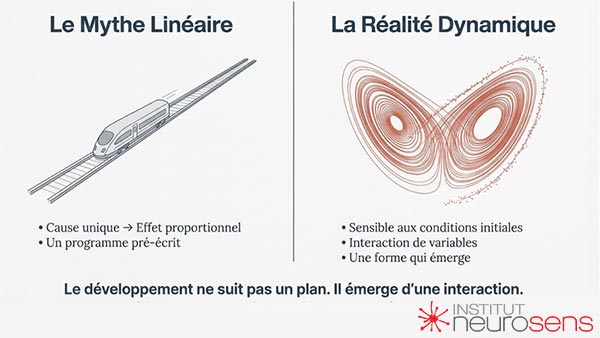
Development is a multi-constrained system.
This approach breaks with the idea of linear brain maturation and with the hierarchical conception of a simple integration of reflexes.
It introduces the concept of self-organisation: motor behaviours emerge from interactions between the body, the environment and physiological constraints, without being predetermined by a single central programme.
2. What "non-linear" means
A non-linear system does not respond proportionally to perturbations.
A small variation can produce:
– either no observable effect
- or a massive change in organisation
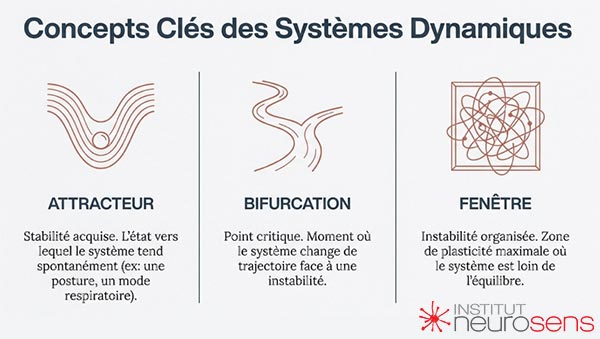
This phenomenon is linked to dynamic attractors.
An attractor is a state towards which a system spontaneously tends.
It is an acquired stability.

A compensated posture can become an attractor.
A respiratory mode can become an attractor.
An attentional profile can become an attractor.
When the system goes through a phase of instability, it can bifurcate.
A bifurcation is a critical point where several trajectories become possible.
Development is punctuated by these bifurcations.
3. Developmental windows as phases of organised instability
We often speak of "sensitive windows".
But we rarely describe them in dynamic terms.
A developmental window is not simply a period favourable to learning.
It is a phase where the system is far from equilibrium.
And a system far from equilibrium becomes more plastic.
The physicist Ilya Prigogine showed that biological systems produce order out of disorder thanks to dissipative structures.
The living organism self-organises when it is traversed by energy flows.
In children, these flows are:
– movement
– respiration
– sensory interaction
– sleep-wake regulation
If these regulations are unstable during a critical window, the system can stabilise a compensatory organisation.
And this compensation can become long-lasting.
4. Ontogenesis and tonico-ventilatory constraints
Postural and ventilatory regulation constitutes one of the first organisers of development.
Axial tone, diaphragmatic coordination, vestibular stability and autonomic regulation form a baseline matrix.
This foundation influences:
– access to intermediate states of alertness
– the quality of brain oscillations
– sensorimotor integration
– attentional availability
When this matrix is unstable early on, the system does not necessarily "dysfunction". It compensates.
But it compensates at an energetic cost.
In a dynamic reading, certain neurodevelopmental disorders can be understood as compensatory attractors stabilised during a particular ontogenetic trajectory.
It is not a simple causality.
It is a trajectory.
5. Minimisation of uncertainty and stability of attractors
The work of Karl Friston proposes that the brain constantly seeks to minimise uncertainty (free energy principle).
An unstable internal system increases predictive uncertainty.
Respiration, tone and sleep then become major variables.
A brain that must compensate for chronic bodily instability consumes more resources to maintain perceptual coherence.
The question is no longer solely cognitive.
It becomes systemic.
6. Implications for an integrative reading
Rethinking ontogenesis in dynamic terms leads to several major shifts:
We no longer look for a single cause.
We observe trajectories.
This notion of developmental trajectory is in line with the work of Alan Sroufe, who showed how much early organisations structure probabilistic developmental continuities rather than fixed determinisms.
We identify the phases of bifurcation.
We act on the global constraints of the system.
The intervention is no longer centred on the isolated symptom.
It aims to modify the dynamic conditions.
Modifying tonico-ventilatory stability, improving autonomic regulation, restoring coherent rhythms: this is not correcting a disorder.
It is modifying the attractor landscape.
7. Towards a pedagogy of transitions
An integrative reading of developmental windows implies a new pedagogy.
Training professionals capable of:
– recognising periods of dynamic vulnerability
– understanding compensation mechanisms
– intervening on primary regulations
– supporting transitions rather than fighting against manifestations
Human development is a process of organised transitions.
And clinical practice then becomes a clinical practice of bifurcations.
To conclude, ontogenesis is not a straight line.
It is a succession of relative stabilities interrupted by non-linear transitions.
Every developmental window is both a vulnerability and an opportunity.
Every compensation is an attempt at balance.
Rethinking development from non-linear dynamic systems allows us to move beyond simplistic causality and open up an integrative reading of the living organism.
It is not about replacing existing models.
It is about adding an explanatory layer more consistent with biological complexity.
And perhaps, in the end, learning to observe development not as an accumulation of functions,
but as a progressive synchronisation of core regulations, of which central desynchronicity in ADHD represents one of the most structuring disruptions.
II. The five pillars as a dynamic architecture:
An integrated regulation architecture
In a non-linear perspective, human development is not the successive maturation of brain areas.
It is the progressive stabilisation of core regulations.
These regulations form dynamic attractors.
And these attractors are organised around five major constraints:
Postural tone
Respiration
Emotions
Cognition
These pillars are not independent.
They co-emerge.

1. Muscle tone: the first dynamic organiser
Tone is not just muscular.
It is the condition for access to action.
Unstable tone modifies:
– perception
– coordination
– attentional availability
– autonomic regulation
In an early ontogenetic phase, tonic instability can orient the system towards a compensatory attractor: adjustment hypertonia, motor restlessness, sensory seeking.
The system does not "dysfunction".
It organises itself differently.
Axial tone constitutes the first functional interface with gravity.
It structures the bodily axis on which the other pillars lean.
2. Respiration: the central synchroniser
Respiration is not just gas exchange.
It is an oscillator.
It synchronises:
– heart rate variability
– cortical arousal
– brain rhythms
– postural oscillations

The work of György Buzsáki has largely shown that the brain functions as an organised oscillatory system, where the synchronisation of rhythms conditions the coherence of states.
Early ventilatory instability can modify accessible states of alertness.
The system then explores other attractors: hyper-arousal, sleep fragmentation, compensatory restlessness.
Respiration is a biological metronome.
In a dynamic reading, it constitutes a transverse regulator of developmental trajectories.
3. Sleep: the stabiliser of transitions
Sleep is often described as restorative.
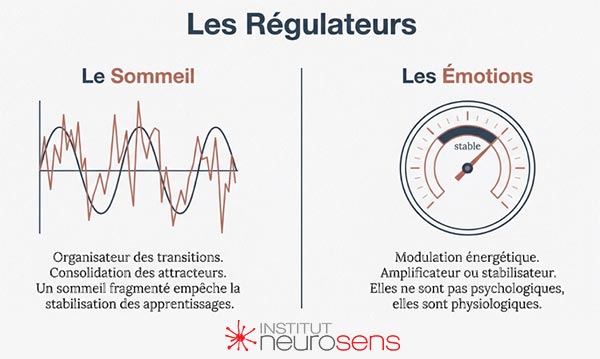
But it is above all an organiser.
Sleep-wake transitions are daily bifurcations.
Fragmented, unstable or poorly regulated sleep prevents the consolidation of adaptive attractors.
The system remains in exploratory or compensatory mode.
Plasticity becomes costly.
In ontogenesis, the first years are marked by a progressive construction of sleep-wake rhythms.
Any significant disturbance during these windows can permanently shape the trajectory.
4. Emotions: energetic and relational regulation
Emotions are not secondary.
They modulate the system's energy.
The work of Edward Tronick on dyadic regulation has shown that emotional development relies on constant interactive micro-adjustments. Stability is not the absence of disturbance, but the capacity to repair.
A human dynamic system is deeply relational.
Chronic emotional instability modifies:
– tone
– respiration
– sleep
– cognition
Emotions are attractors modulators.
They amplify or stabilise organisations.
They are not only psychological.
They are physiological.
5. Cognition: regulated emergence
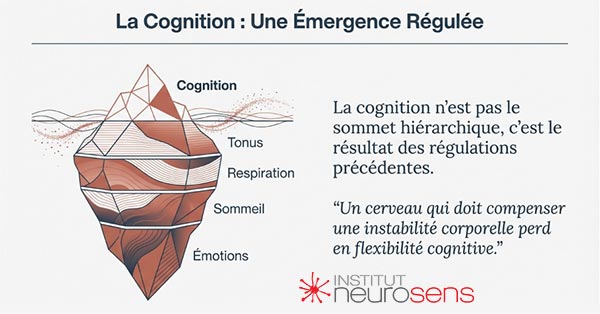
Cognition is not the hierarchical summit.
It emerges from preceding regulations.
A stable tonico-ventilatory system facilitates:
– access to intermediate states
– attentional modulation
– cognitive flexibility
In a dynamic perspective, certain cognitive difficulties are not isolated deficits.
They are the visible expression of a global attractor.
Cognition reflects the state of the system.
III. Clinical illustrations
If we consider ontogenesis as a succession of bifurcations, the five pillars represent the main constraints that guide these bifurcations.
Each pillar influences the others.
Respiratory instability can modify tone.
Unstable tone modifies sleep.
Fragmented sleep affects emotion.
Unstable emotion disrupts cognition.
And vice versa.
We can no longer think in terms of a causal chain — misleading correlations and circular causality in ADHD are the most direct illustration of this.
We must think in terms of a dynamic network.
Major implication
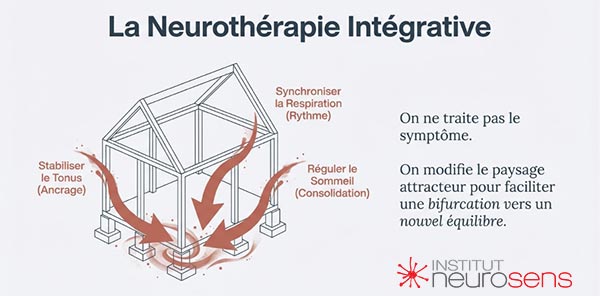
Integrative neurotherapy does not "treat" an isolated pillar.
It modifies the dynamic constraints of the system.
By stabilising tone.
By synchronising respiration.
By improving sleep.
By supporting emotional regulation.
By facilitating cognitive emergence.
We act on the attractor landscape.
It is a trajectory modification, not a symptom suppression.
Clinical box
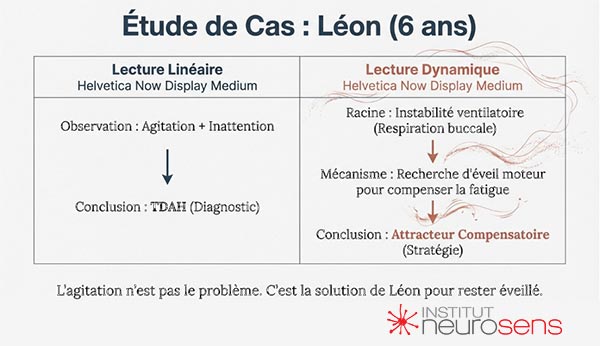
Let us take a simplified example. Léon, 6 years old.
Motor restlessness, difficulty paying attention, late falling asleep.
Anamnesis: early mouth breathing, fragmented sleep in infancy.
Classic linear reading:
Hyperactivity → attentional disorder → ADHD diagnosis.
Dynamic reading:
Early ventilatory instability.
Difficulty accessing intermediate states of alertness.
Motor restlessness as a compensatory arousal attractor.
Sleep fragmentation reinforcing instability.
Progressive stabilisation of a "compensatory hyper-arousal" attractor.
The symptom becomes a stable organisation.
The intervention does not aim to eliminate restlessness.
It modifies constraints:
– ventilatory re-education
– tonic stabilisation
– sleep improvement
– self-regulation training
Progressively, the system explores a new attractor.
The trajectory changes.
Clinical box

Maël – Dynamic reading of a developmental trajectory
1. Gestation and neonatal period
Pregnancy marked by significant maternal fatigue and sleep disturbances in late pregnancy.
Delivery without major complications.
The first months are described as "restless":
– fragmented sleep
– frequent awakenings
– difficulty falling asleep
– noisy breathing
No formal diagnosis is made at this stage.
Possible dynamic reading:
the first sleep-wake and ventilatory regulations seem unstable.
The system enters early into a compensation dynamic.
2. Infancy (0–3 years)
Maël presents:
– persistent mouth breathing
– repeated ENT infections
– significant motor restlessness
– difficulties falling asleep
– frequent night awakenings
Motor acquisition is rapid but not very stable:
he walks early, runs a lot, falls frequently.
Dynamic hypothesis:
nocturnal ventilatory instability → fragmentation of deep sleep states → increased corticalisation of arousal.
The body becomes a regulator of arousal.
Restlessness begins to settle in as a compensatory attractor.
3. Preschool age (4–6 years)
Teachers describe:
– difficulty with sustained attention
– constant need to move
– impulsivity
– fatigue in the late morning
Sleep remains unstable.
Intermittent snoring reported by parents.
On a postural level:
– axial instability
– asymmetrical supports
– difficulty maintaining a static posture
Here we find the triad described in the work of Rémi Valentin:
Mild OSA suspected
↑ corticalisation of arousal
compensatory postural adaptation
This triad does not constitute a mechanical causality, but a framework for dynamic interpretation.
4. Polysomnography (PSG) report
The PSG highlights:
– mild OSAHS
– high micro-arousal index
– frequent autonomic activations
– decreased slow-wave sleep
– elevated PLMS
There is no severe apnoea.
But there is an instability of sleep-wake transitions.
Dynamic reading:
the system does not efficiently consolidate its nocturnal attractors.
Daytime arousal becomes costly.
5. Quantitative EEG (qEEG)
The qEEG shows:
– deficit in low-alpha (8–10 Hz)
– increased state variability
– tendency towards hyper-arousal
– unstable SMR activity
This profile does not indicate a "structural deficit".
It reflects a functional state of regulation.
In a non-linear reading:
ventilatory instability + sleep fragmentation
→ difficulty accessing intermediate states
→ compensatory hyper-arousal
→ unstable attentional attractor
Cognition appears as an emergent consequence.
6. Integrative dynamic hypothesis
Proposed chronology:
Early ventilatory instability
Fragmentation of sleep states
Excessive corticalisation of arousal
Compensatory motor restlessness
Progressive stabilisation of a hyper-arousal attractor
It is a developmental trajectory guided by dynamic constraints.
7. Intervention in integrative neurotherapy
The intervention does not target the isolated attentional symptom.
It targets systemic constraints:
Respiration
– nasal breathing re-education
– diaphragmatic coordination
– work on oro-pharyngeal synchrony
Sleep
– stabilisation of routines
– reduction of autonomic activations
– work on parasympathetic regulation
Muscle Tone
– dynamic postural exercises
– proprioceptive stimulation
– work on anticipatory postural adjustments
Self-regulation
– heart rate variability biofeedback
– neurofeedback targeting SMR stability
– progressive training in intermediate states
8. Outcome
After several months:
- decrease in restlessness
- improvement in falling asleep
- reduction in micro-arousals
- more stable posture
- better attentional availability
The progression is not linear.
It shows transition phases.
The system progressively explores a new, more stable attractor.
What this case illustrates
Maël does not present an "isolated disorder".
He embodies an ontogenetic trajectory influenced by early tonico-ventilatory instability.
The triad:
Mild OSA
↑ corticalisation of arousal
postural adaptation
becomes readable in a non-linear dynamic framework.
Integrative neurotherapy does not intervene as a corrector of a deficit.
It modifies the constraints of the system to allow an adaptive bifurcation.
IV. Limitations of the model
This dynamic model does not claim to explain all developmental trajectories, nor does it establish a direct causal link between early tonico-ventilatory instability and the subsequent appearance of attentional symptoms.
Several limitations must be explicitly acknowledged:
– Not all children presenting early respiratory instability develop an attentional disorder.
– Developmental trajectories are influenced by multiple genetic, environmental and relational variables not taken into account here.
– The clinical data presented fall within an integrative reading and do not constitute an experimental demonstration.
– The model relies on a theoretical convergence from developmental sciences, neurosciences and physiology, but still requires specific longitudinal validations.
It is therefore an interpretative framework aiming to organise disparate clinical observations, not an exhaustive explanatory model.
V. Towards a profession of readers of the living
While this theoretical framework remains partial and perfectible, it nonetheless calls for an evolution of the professional posture.
If development is envisioned as a non-linear dynamic system, then intervention cannot be limited to applying a standardised protocol. It implies a capacity to read trajectories, to recognise phases of instability, to understand compensations and to identify the attractors that structure the system's organisation.
This skill belongs neither exclusively to the medical field, nor solely to the psychological or educational field. It requires a transversal approach, integrating physiology, development and regulation.
In this perspective, training no longer consists only in transmitting techniques, but in developing a capacity for systemic analysis and methodological rigour.
Such an evolution implies constant dialogue with research, sleep medicine, developmental psychology and movement sciences. It also requires critical vigilance in order to avoid any technicist or dogmatic drift.
It is not about establishing a new exclusive model, but about opening an interdisciplinary space of reflection capable of integrating the complexity of human development.
This shift is not merely technical. It is epistemological.
It transforms the way we observe, interpret and decide.
The question is no longer solely:
"How to intervene?"
It broadens to:
"How to train professionals capable of thinking about and supporting complexity without reducing it?"


