Out-of-tune attention: what qEEG teaches us about the brain-body connection

What if a child's inattentiveness was not just a "lack of attention", but the reflection of a deep mismatch between their brain and body rhythms?
A vast Italian study conducted on more than 1000 children aged 7 to 14 explored the link between ADHD symptoms and executive difficulties (organisation, planning, self-regulation).
click on link to read the article
The results are enlightening: inattention and executive disorders are conceptually distinct, but in daily life, they are closely intertwined.
Teachers often perceive a global picture — where inattention and organisational difficulties blend —, whereas parents distinguish the two more. But one point stands out clearly: it is inattention, much more than hyperactivity, that is strongly associated with executive disorders.
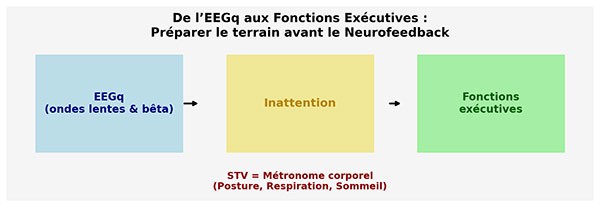
This finding calls for a more nuanced interpretation: the inattentive child is not simply distracted, they often suffer from a physiological regulation deficit that prevents their executive functions from deploying fully.
In this article, Joël Lemaire explains to us how quantitative EEG (qEEG) and the regulation of the Tonico-Ventilatory System (TVS) allow us to understand and support these children differently — by retuning their body and brain rhythms.
Happy reading
— Guylaine Bédard
When qEEG sheds light on the invisible
This is where quantitative EEG (qEEG) becomes a highly valuable clinical and educational tool.
It is not a magic map locating a "faulty" brain area, but a mirror of brain rhythms and their agreement (or disagreement) with states of vigilance, cortical arousal, and cognitive availability.
Clearly, qEEG helps us understand if the child actually has the level of physiological arousal necessary for attention and planning.
A profile frequently observed in inattentive children associated with:
a deficit in slow waves, often linked to cortical under-arousal (a potential consequence of a sleep-related breathing disorder),
and a lack of beta waves, reflecting a difficulty in maintaining attentional effort and cognitive activation.
These qEEG signatures correspond precisely to the profile described in the study: an inattentive child with fragile executive functions. Here, qEEG acts as a physiological mirror of what parents and teachers observe in daily life.
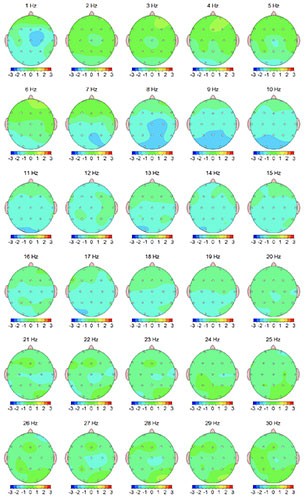
These brain rhythms cannot be understood on their own: they reflect the body's overall state of regulation.
This is why reading qEEG, in an integrative neurotherapy approach, is not limited to the brain — it dialogues with breathing, muscle tone, and sleep.u0001
The trap of brain localisation
It is tempting to believe that a qEEG would tell us which "area" to train, for example by relying on Brodmann areas or source localisation software like LORETA.
But science warns us:
Current methods of source localisation are not validated to provide an exact individual clinical map.
qEEG is above all a frequency measurement: it provides information on the overall balance of brain rhythms, not on a postal address in the cortex.
Reducing qEEG to a localisationist reading is therefore an illusion.
What matters is the harmonisation of brain rhythms with underlying physiological states: vigilance, breathing, muscle tone, and sleep.
« qEEG does not show a localised breakdown, but the way the orchestra of brain rhythms tunes in — or detunes — with breathing and muscle tone. »
The founding role of the TVS
In applied neuropsychophysiology, it is accepted that no cognitive function can be performed without a stable physiological base.
Attention, working memory, or planning all rely on brain rhythms modulated by bodily regulation systems.
The Tonico-Ventilatory System (TVS) acts as a discrete metronome, coordinating postural tone, breathing, and sleep to maintain alertness during the day and ensure consolidation at night.
Three axes to examine:
Postural tone: assessing the stability of posture maintenance and attentional availability without hypertonia. Antigravity muscles provide anchoring but must not overcommit.
They serve as a basis for anticipatory postural adjustments (APAs), which stabilise variations in internal rhythms (ventilation, heart rate).
The work of Clavel (2020) and Valentin (2025) has shown how much a postural imbalance can be linked to an alteration in cortical arousal and executive functions.Ventilation: analysing the respiratory mode (nasal or mouth), cycle regularity, and diaphragmatic and thoracic synchronisation.
Paradoxical breathing disrupts the agreement between body and brain rhythms.
As shown by Quercia (2013), nearly 95% of dyslexic children present paradoxical breathing, a sign of a muscle tone and ventilatory regulation defect.Sleep: assessing the quality of falling asleep, sleep continuity, and restorative cycles.
Deep sleep supports memory consolidation and cortical homeostasis; REM sleep promotes emotional and cognitive plasticity.
When these three pillars of the TVS are aligned, "the lights turn green": the body is ready to support brain training.
The limitations of isolated NFB
Neurofeedback (NFB) can have spectacular effects in the short term… but they are transitory.
The first protocols of 12 to 15 sessions often show an improvement in behaviour, but this relies largely on non-specific effects: the child's motivation, parents' expectations, and a positive relational climate.
Yet, the follow-up qEEG does not lie: most of the time, the deficiency profile persists.
Improvements are not maintained because the body was not prepared.
Without prior regulation of the TVS, NFB remains a contextual aid, not a lasting transformation.
Why the HAS remains cautious about neurofeedback
The Haute Autorité de Santé (HAS) (French National Authority for Health) does not currently recommend neurofeedback as an isolated management option for ADHD.
This reservation is understandable if we consider that:
- The limitations of available studies: the majority of clinical trials evaluate NFB by comparing it to medical treatment or cognitive management, without taking into account non-specific effects (placebo, expectations, therapeutic relationship).
- The absence of bodily integration: this research does not evaluate the role of muscle tone, breathing, or sleep, which are nevertheless essential for cognitive availability. They test NFB "off-soil", like a technical protocol applied to the brain, without physiological preparation.
- A restricted epistemological framework: causality is thought of linearly (from the brain to behaviour), whereas neuropsychophysiology data shows circular interactions between body, rhythms, and cognition.
Viewed from this angle, it is logical for the HAS to conclude that efficacy is limited. But the very design of what is being evaluated is what is at stake.
However, it is precisely this model that needs to be surpassed.
Changing the paradigm is not about refuting science, but broadening it:
considering NFB not as an isolated technique, but as a piece of an integrative process,
placing the body (TVS) back at the centre of clinical reading,
and measuring progress over time using qEEG coupled with physical observation.
« For students in integrative neurotherapy, this observation highlights the importance of always placing the qEEG reading in the overall context of the body. The interpretation of a scan must be correlated with the child's posture, breathing, and sleep profile. »
A visible and measurable progression
This integrative approach offers two major benefits:
Measurability: each stage (initial qEEG, TVS regulation, then NFB) provides concrete and visible benchmarks, understandable for parents and teachers alike.
Progressiveness: the body and its fundamental rhythms are prepared first, and then the brain is trained, respecting the principle of progressive maturation of adaptive systems.
When the TVS is regulated, clinical observations converge:
The number of NFB sessions decreases.
The results stabilise over time, bearing witness to a real neurophysiological maturation.
For students in training, this progression perfectly illustrates the logic of integrative neurotherapy: evaluate, synchronise, train, consolidate.
Conclusion
The Italian study has shown how closely associated inattention is with executive functions.
qEEG offers an objective interpretation of this, by revealing the state of synchronisation between the brain and the body.
Preparing the ground through TVS regulation before neurofeedback allows the child to build lasting learning rather than ephemeral adjustments.
It also offers parents and teachers concrete, measurable benchmarks that bring hope.
It is time to think of attention no longer as an isolated brain function, but as a living symphony between the body and the brain.
Integrative neurotherapy teaches us how to conduct this symphony.


