Burnout: what if stress were a routing error?
Science is starting to talk about recovery… but still forgets what makes it possible
Burnout is everywhere. Recently reported figures suggest that nearly two out of three employees say they are affected by some form of work-related exhaustion, while the WHO continues to describe it as an occupational phenomenon. Yet, despite this growing recognition, the question is still often poorly framed. Because the problem is perhaps not stress itself, but the progressive loss of the living system's capacity to recover, to bounce back, to adjust. And this is where our reading diverges.

Listen to the audio version of this article
Introduction
Burnout has become a commonplace word. Too commonplace, perhaps. It is used to describe a temporary fatigue, professional weariness, a drop in motivation, sometimes even just a need for a holiday. But behind this trivialisation lies a much more serious reality: professional exhaustion has established itself as a massive, structural, long-term phenomenon.
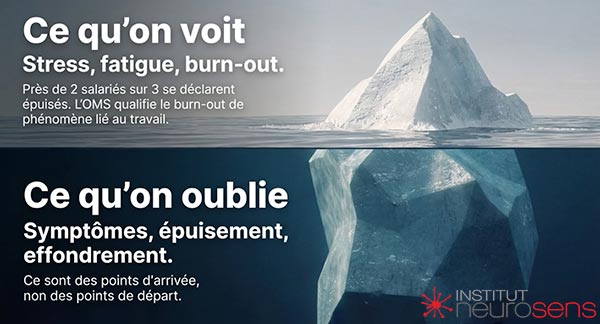
As highlighted in a recent article published in Science & Vie, nearly two out of three employees today say they are affected by some form of work-related exhaustion, a sign of a phenomenon that has become massive. At the same time, the classic answers offered in the workplace — yoga, occasional meditation, well-being breaks, shortened weeks — are clearly not enough to reverse the trend. The WHO, for its part, characterises burnout as an "occupational phenomenon", defined by a now well-known triptych: exhaustion, mental distance or cynicism towards work, and reduced professional efficacy.
We must take this signal seriously. Because if this many people say they are exhausted, it is no longer an individual accident. It is a sign that an entire model of understanding and prevention has now reached its limits.
And yet, even in recent approaches that claim to be based on neuroscience, something still seems insufficient to us. Contemporary science is beginning to better recognise the central role of recovery and is slowly moving away from a simplistic reading where all you have to do is "manage your stress better". But it still, all too often, remains suspended in a cerebrocentric, psychologising, or organisational view of the problem.
In other words: it is starting to see that stress is not the real core of burnout… without yet going as far as the system that makes recovery possible.
This is where we propose another starting point.
For stress is not an anomaly. It is part of life.
Without stress, there would be no adaptation, no mobilisation, no living response to the environment. The real issue is therefore not to eradicate stress, but to understand why, in certain people, the system is no longer able to return to its equilibrium. Why it no longer recovers. Why its adaptive margin shrinks until it collapses.
Burnout is then no longer just a problem of workload, mindset, meaning or organisation. It becomes the late name of a living system that has lost its capacity to adjust.
This is the hypothesis we would like to explore here.
1 — Burnout is everywhere… but is still poorly understood
First, we must recognise what current science says: something important is shifting. Burnout is no longer seen as a simple individual weakness or a whim of a fragile employee.
The article in Science & Vie has the credit of reminding us of the scale of the phenomenon: two out of three employees say they are now affected by some form of exhaustion, a sign of a deep unease that goes far beyond a simple "bout of fatigue".
The text also reminds us that the WHO does not speak of burnout as a personality trait or a moral disorder, but as an occupational phenomenon. This distinction is important. It already helps to move away from judgment. Burnout is not primarily a question of character. It does not only affect people who are "too fragile" or "less resilient".
This is where a first major confusion arises.
Because, in common discourse, professional exhaustion is still very often thought of as an excess of stress: too much work, too much pressure, too many demands, too many solicitations. This reading is not incorrect. But it is too short. It describes the intensity of the constraint, without yet saying what makes a system able or unable to continue responding to it at any given moment.
An idea is, however, beginning to emerge ever more explicitly: the problem is not so much the exposure to stress… as the growing difficulty in recovering from it.
In other words, it is not solely the intensity of the constraints that leads to exhaustion, but the progressive loss of the mechanisms that allow the system to return to equilibrium.
What sets in then is not simply fatigue. It is a dynamic of confinement: the less a person recovers, the more they must exert compensatory effort to maintain their level of functioning; the more this effort increases, the more exhaustion sets in; and the more exhaustion progresses, the less recovery capacity remains available. Contemporary models of recovery at work describe well this articulation between stressors, lack of recovery, and degradation of well-being.
We are at a very important turning point here.
For this way of framing the problem is already more accurate than the old opposition between acute and chronic stress. It opens up another question: if two people can be subjected to comparable constraints, why does one still recover while the other collapses? Why does one maintain room for manoeuvre while the other enters a spiral of exhaustion?
In other words: burnout cannot be understood solely by the intensity of the stressors. It must be interpreted through the capacity of the system to return, to repair, and to reorganise itself after effort.
And this is precisely where, in our view, mainstream science stops too soon.
It is starting to recognise that recovery is central. But it still too often leaves the decisive question in the dark: what makes recovery possible?
It is this question that will lead us, in what follows, to move away from a merely psychological or brain-centred reading of burnout to return to a more fundamental physiology of life.
2 — The central myth: "stress is the problem"
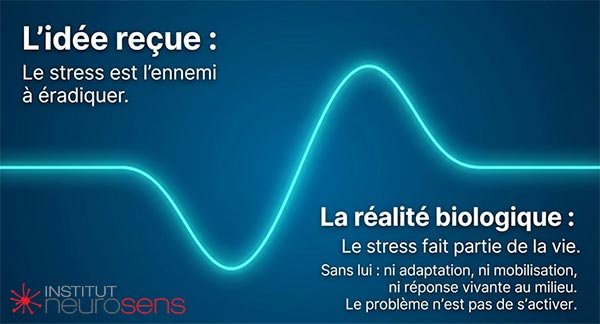
This is undoubtedly the most established idea, and yet one of the most misleading.
When we talk about burnout, almost everyone starts by talking about stress. Too much stress. Acute stress. Chronic stress. Stress management. Stress reduction. As if professional exhaustion could be summed up as an excessive accumulation of external tensions.
This way of framing the problem is understandable. It is simple, intuitive, and socially accepted. It also allows lived experience to be named. But, on its own, it remains insufficient.
For stress is not, in itself, an anomaly.
It is a normal function of life.
Without stress, there would be no mobilisation, no adaptation, no response to the environment. Stress allows the organism to set itself in motion when faced with a constraint, a danger, an emergency, or even a challenge. In this sense, it is not opposed to health. It is part of it.
This is where the confusion begins.
By making stress the main culprit, we end up targeting the wrong mark. We treat activation itself as a deviation, when it is primarily a normal component of adaptive life. What becomes pathological is not the fact that a system activates. It is the fact that it can no longer return to baseline.
In other words: the problem is not stress.
The problem is the growing difficulty in recovering from it.
This nuance changes everything. For it radically shifts the centre of gravity of the reflection. We no longer ask only: "What produces too much stress?" We ask: "What prevents the system from recovering after stress?"
And this question is much more demanding.
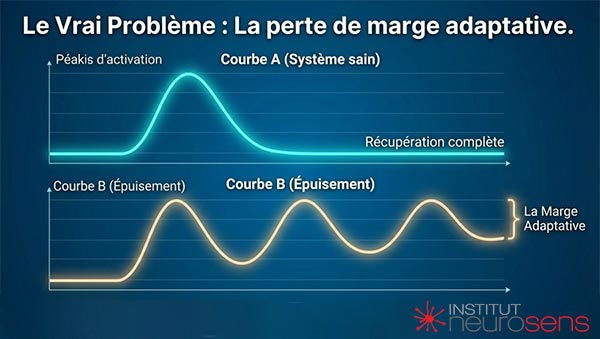
It forces us to move away from a purely quantitative model, where we would only measure the intensity of the constraints, to enter into a dynamic model, where what matters is the capacity of the system to oscillate between activation and return to baseline.
Two people can face comparable workloads, similar responsibilities, and the same context of pressure. Yet, one will continue to hold up, while the other will progressively become disorganised. Why? Certainly not because one is "strong" and the other "weak". But because their adaptive capacity is not the same at that given moment.
Burnout therefore does not reveal just an excess of pressure. It reveals a loss of margin. A progressive reduction in the available adaptive margin.
This is why the often-proposed distinction between acute and chronic stress, although useful descriptively, is not enough to think about burnout in depth. It says something about the temporality of the constraint, but still too little about the state of the system undergoing it.
The problem is not that the organism activates.
The problem is that it eventually has to remain activated to continue functioning.
At that point, activation is no longer a flexible response to the environment. It becomes a survival mode. The system is still holding on, but by consuming its reserves. It compensates. It tightens. It struggles. It moves forward without truly recovering.
Viewed from this angle, burnout appears less like a temporary overload and more like the culmination of a long-standing imbalance between mobilisation and recovery.
We do not collapse simply because there was too much demand.
We collapse because, progressively, the capacity to recover between these demands has shrunk.
This perspective in no way minimises the reality of work, toxic managerial contexts, absurd demands, or organisational violence. It does not exonerate the environment. It simply allows the problem to be formulated better: the same workload does not have the same effect depending on the state of the system exposed to it.
This is precisely where the notion of adaptive margin becomes more fruitful than that of stress.
3 — What science is starting to see — and why it is already progress
It would be unfair to say that science has not evolved in its way of understanding burnout. On the contrary, the last few years have seen a real shift in perspective.
For a long time, the dominant response was limited to a relatively simple logic: identify sources of stress, try to reduce them, and teach individuals to cope better. This approach made it possible to put words to certain types of suffering, but it also showed its limits.
What is progressively changing is the attention paid to recovery.
More and more studies point out that burnout cannot be understood solely as an accumulation of constraints, but that it involves an alteration of the fundamental cycles of rest, regulation, and recovery. Sleep, breaks, work rhythms, and the ability to disconnect are now identified as key factors. Contemporary models of recovery at work have been moving in this direction for several years.
This shift is important.
It allows us to move away from an overly simplistic view where one would simply need to "reduce the pressure" to solve the problem. It recognises that the human organism functions according to cycles, alternations, and oscillations. It implicitly admits that exhaustion is not only linked to what we undergo, but to the way the system manages — or fails — to restore itself between two phases of activity.
In other words, science is beginning to integrate an essential idea: burnout is not just too much stress, but a lack of recovery.
This point is fundamental. It marks a break with purely quantitative approaches to stress. It opens the way to a more dynamic understanding, where we are no longer interested only in the intensity of the demands, but in the capacity of the system to maintain a balance over time.
However, this progress remains partial.
Because although recovery is now recognised as central, it is often envisioned through solutions that are still relatively superficial or indirect: improving lifestyle habits, promoting rest, developing relaxation practices, encouraging mindfulness, adjusting work organisation. All these approaches have their merit.
But they still leave a decisive question in the shadows: what, in the very functioning of life, makes recovery possible?
Why, under comparable living conditions, do some people still manage to restore themselves, whereas others enter a spiral of exhaustion? Why, for some, is a night of sleep enough to bounce back, while for others, even rest no longer seems truly restorative?
In other words, recovery is identified as a major issue… but it is still too often thought of as a consequence to be supported, rather than as a function to be understood.
This is where, in our view, lies the current limit of dominant approaches.
4 — A persistent limit: neuroscience still too focused on the brain
The introduction of recovery into recent models of burnout constitutes a major step forward. But at this stage, a major limit persists.
Even when they mobilise neuroscience, most current approaches still remain largely brain-centred.
They talk about neural networks, emotional regulation, cognitive overload, rumination, mental flexibility. The discourse is becoming more precise and sophisticated.
But it remains, most of the time, suspended in the same implicit logic: that of a brain that we try to understand — and sometimes regulate — relatively independently from the rest of the body.
The body is indeed present, but often in the background. Like a support. Like a context. Like a consequence.
It is rarely placed as the central ground from which the understanding must be organised.
This is where the discrepancy appears.
For if we consider that burnout is due to an alteration of recovery processes, then it becomes difficult to maintain a strictly cerebral reading of the phenomenon. Recovery is not a function located in one area of the brain. It cannot be reduced to a more or less peaceful mental activity. It involves the entire living system.
It involves deep dynamics of:
muscle tone,
breathing,
state of alertness,
sleep-wake rhythms,
postural and behavioural adjustment.
In other words, it is a matter of global organisation.
This does not mean that current neuroscientific approaches are wrong. They bring valuable elements. But they remain, in our view, incomplete as long as they do not fully reintegrate the bodily dimension as a starting point, and not just as a simple consequence.
Because the brain never functions alone.
It is permanently embedded in a set of respiratory, postural, autonomic, and rhythmic regulations. It does not command a passive body. It participates in a dynamic system in which each level influences the others.
In this perspective, the question of burnout can no longer be asked solely in terms of cognitive overload, psychological pressure, or emotional dysregulation. It must be replaced within a broader reading, focusing on how the entire body-brain system manages — or fails — to maintain its capacity to adjust.
5 — The true forgotten question: what makes recovery possible?
From the moment we admit that burnout cannot be understood without recovery, one question becomes unavoidable: what does this capacity to recover actually depend on?
This question seems simple. In reality, it shifts everything.
For as long as recovery is thought of as a simple side effect of rest — sleeping more, taking a break, relaxing, slowing down — we are still just skimming the surface of the problem. Yet, everyone has experienced it: rest does not always repair. Sleep does not always restore. A break does not always soothe.
In other words, recovery is not automatic.
It is a function of life.
And like any function of life, it depends on the state of the system that must perform it.
This is where the concept of adaptive margin becomes decisive.
We call adaptive margin the residual capacity of an organism to respond to a constraint, mobilise its resources, and then return to its equilibrium. It designates, in a way, the reserve of flexibility that the system still has to oscillate between activation and recovery without exhausting itself in the process.
This idea profoundly changes how we think about burnout.
Because it allows us to move away from a binary logic — stress or no stress, overload or no overload — to enter into a dynamic logic: how much margin does the system still have to adjust?
Two people can face comparable constraints and yet not experience the same trajectory. One can be highly solicited without collapsing, because their system still retains capacities to return to baseline. The other may seem to "hold up" for a time, but at the cost of a permanent compensatory effort that progressively depletes their reserves.
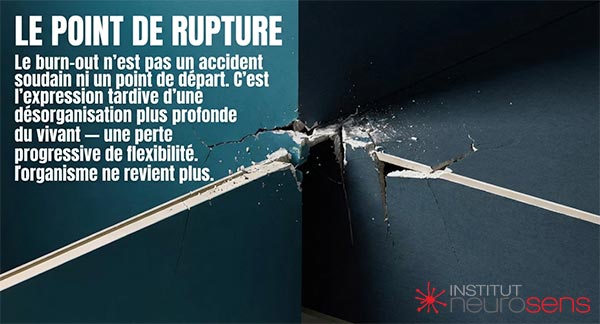
Burnout then no longer appears as a sudden accident.
It becomes the late expression of an adaptive margin that has progressively shrunk.
What collapses is not just motivation. It is the capacity of the living system to alternate in a flexible way between mobilisation and restoration.
The real question is therefore not only:
"What level of stress is the person exposed to?"
But rather: "What is still their power to return?"
Can they return to their baseline?
Can they release after effort?
Can they recover without remaining partially activated?
Health is not the absence of stress.
It is the capacity to vary, to adjust, and then to return.
It is a capacity for oscillation.
And when this oscillation becomes difficult, costly, or incomplete, the organism enters a zone of fragility that can remain invisible for a long time. The person sometimes continues to work, think, decide, and deliver. But they do so with an increasingly reduced margin. They compensate more than they recover. They hold on, but never truly return.
Burnout is therefore not primarily a problem of quantity of stress.
It is a problem of quality of return.
6 — The adaptive margin is based on a concrete living system: the TVS
But this adaptive margin does not float in the abstract.
It depends neither on a simple "mental strength" nor on a better-trained will. It is based on a concrete, continuous, deeply embodied living system that organises at every moment our way of being alert, mobilising, recovering, and acting.
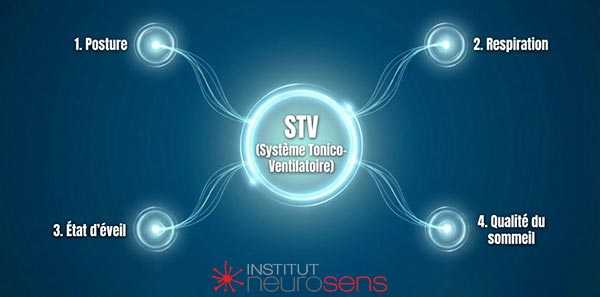
This is what we call the tonico-ventilatory system, or TVS.
This system permanently connects:
postural tone,
ventilation,
state of alertness,
the quality of recovery,
and the very possibility of adjusted action.
In other words, this is not a secondary mechanism. The TVS constitutes a central armature of life. It supports our verticality, our breathing, our attentional availability, our emotional stability, our sleep, and our capacity to return to baseline after effort.
It is this system, to a large extent, that makes the oscillation between mobilisation and recovery possible.
When this system is flexible, the person can activate without getting lost in the activation. They can respond to a constraint, then return. They can cope, then release.
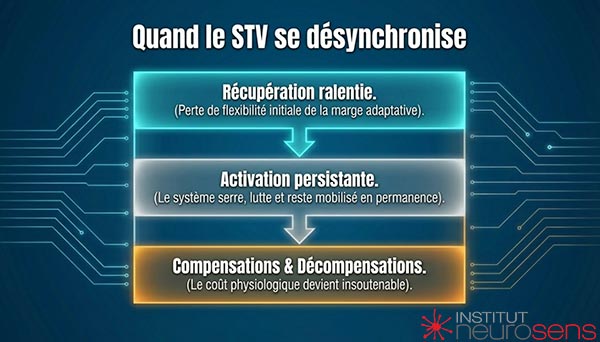
But when this system becomes desynchronised, something changes deeply.
Posture becomes more costly.
Breathing loses its fluidity.
Alertness becomes less stable.
Sleep becomes less restorative.
Effort requires more compensation.
And, progressively, the capacity to return to baseline shrinks.
Viewed from this angle, the adaptive margin is no longer a vague concept. It becomes readable as the functional expression of a system that is more or less coordinated in its most fundamental regulations.
This is, in our view, where the blind spot of current approaches lies.
They talk about stress, sometimes about recovery, sometimes even about the regulation of the nervous system. But they still ask too few questions about the concrete system that coordinates, in the living body, breathing, muscle tone, alertness, and restoration.
Yet, it is precisely this architecture that we must learn to read.
For burnout does not appear only when there is "too much work". It appears when the system responsible for supporting adjustment can no longer absorb, modulate, and then dissipate the constraint.
Burnout then becomes the late expression of a longer-standing, more global, and quieter desynchronisation.
7 — By day, the system compensates. By night, it is revealed
It is perhaps here that the difference in reading becomes most concrete.
When the tonico-ventilatory system becomes desynchronised, it does not immediately produce burnout. It first begins by modifying, often silently, how the person holds themselves, breathes, activates, recovers, and compensates.
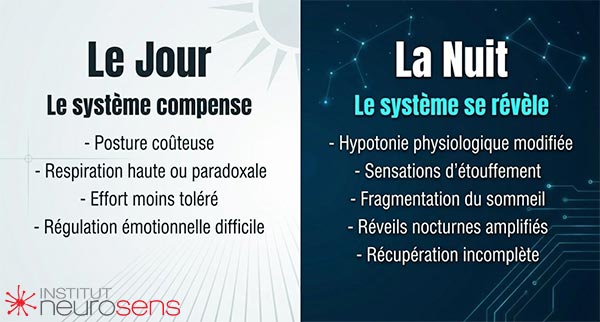
By day, this desynchronisation often remains barely visible. The person continues to function. They work, think, decide, deliver, and move forward. But they do so at an increasing cost.
Posture becomes more demanding.
Breathing tends to shorten, becoming high, thoracic, sometimes paradoxical.
Alertness loses its stability.
Effort requires more control.
Emotions are less easily regulated.
Availability becomes more fragile.
In other words, the system continues to respond, but it responds by compensating.
Viewed from the outside, the person still seems to be holding up. They sometimes even project an image of great strength. But internally, they return to baseline less and less. They no longer truly recover. They remain partially activated, tense, and mobilised.
By night, on the other hand, something is revealed.
For sleep requires the system to be able to release, reorganise, restore its balances, and coordinate muscle tone, breathing, and states of vigilance differently. And this is precisely where the fragilities in regulation often appear most clearly.
When the TVS is desynchronised, sleep can cease to be fully restorative.
Ventilation becomes more vulnerable.
Respiratory flow can change.
Micro-arousals appear.
Sensations of choking, whether conscious or not, can fragment the night and feed an underlying anxiety.
Recovery becomes incomplete.
What is not regulated at night then reappears during the day: fatigue upon waking, difficulty mobilising, emotional hypersensitivity, underlying tension, increased compensatory effort, and reduced cognitive availability.
Daytime troubles and nighttime troubles are therefore not separate.
They are two sides of the same system.
By day, the system compensates.
By night, it is revealed.
This formula perhaps best summarises what our reading tries to bring.
Burnout cannot be understood solely from stressors, thoughts, beliefs, or work organisation, even if all of that matters. It is also understood from this deeper continuity between waking and sleeping, between action and recovery, between the visible constraint of the day and the quieter impossibility of restoration at night.
From this starting point, burnout ceases to be just a problem of workload or psychological fragility. It becomes the culmination of a progressive desynchronisation of life, whose manifestations are distributed in time long before the visible collapse.
This is why our question is no longer just:
how to reduce stress?
It becomes:
how to read, support, and restore the system's capacity to return?
Conclusion
Stress is not the enemy. It is a normal function of life.
The real problem begins when the system can no longer recover after responding to the world.
Burnout is then neither a moral weakness, nor a simple overload, nor a pure excess of pressure. It is the late expression of an adaptive margin that has shrunk, until returning to baseline is no longer possible.
Science is starting to recognise the importance of recovery. That is progress. But as long as it does not fully question the living system that makes this recovery possible, it risks stopping too soon.
This is where our reading diverges.
And this is perhaps also where another way of preventing burnout can begin.
Because all of this is not just thinkable.
It is also, at least in part, measurable.
Measurable in the way an organism activates itself.
Measurable in the way it recovers.
Measurable in the quality of its return to baseline.
Measurable in its rhythms, its ventilation, its alertness, its variability, and its compensations.
In other words: before the visible collapse, there are often already readable signs of a shrinking adaptive margin.
And this is precisely what opens a new perspective:
no longer waiting for burnout to name it,
but learning to spot, objectively measure, and support earlier the capacity of life to return.


