What if it all started with postural tone?
From reflex to posture: history of a bodily misunderstanding
In a world where neurodevelopmental disorders are often approached through fragmented reading grids — psychological, educational, biomedical, or behavioural — it becomes urgent to revisit the very foundations of child development. Postural tone, this discrete conductor of living elements, constitutes one of the forgotten keys to this global reading.
This article retraces the little-known but crucial history of methods centred on archaic reflexes, born in Eastern Europe during the Cold War and then taken up in the West in a context of searching for educational meaning. It questions the origins and boundaries of these approaches, but above all, proposes a renewed vision, rooted in recent contributions from psychophysiology, developmental neuroscience, and integrative clinical observation.
A founding text to understand why posture cannot be dissociated from breath, attention, emotion... and human history itself.
ADHD Francophone Summit by the Neurosens Institute
from 28 September to 7 October
Online - FREE Registration

🌀 What if everything started… with postural tone?
When a child struggles to stand up straight, sit still without fidgeting, coordinate their movements, or catch their breath, we often think of a lack of attention, "ADHD", or even poorly integrated primitive reflexes.
But are these manifestations not, indeed, the symptoms of a deeper disorganisation?
What if the root of all this… was postural tone?
A living framework woven from intra-uterine life
Postural tone: living expression of the central nervous system
Even before talking about posture or motor skills, it is fundamental to understand what tone actually is.
Postural tone is not a "contracted muscle", nor a "straightened posture". It is a living, adaptive manifestation, resulting from the regulation of the central nervous system as a whole:
The brainstem, subcortical nuclei, cerebellum, spinal cord, motor and sensory cortex — all these structures cooperate constantly to adjust the body's tonic balance to gravity, movement, perception, emotion.
This tone follows a universal law of development, well described by the pioneers of neurophysiology like Jacques Paillard, André Thomas, or Marc Jeannerod: the cephalo-caudal law, according to which tonic maturation occurs from head to toe. First cephalo-rectification and oculomotor control, then stabilisation of the trunk, finally the integration of support and locomotion.
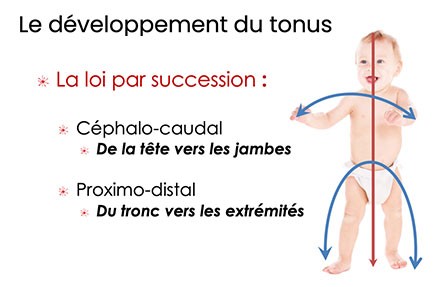
👉 This law is all the more valuable as it offers a hierarchical reading of development. When a child presents motor or attentional difficulties, it is essential to first examine the quality of their tonic adjustments in a sitting position, then the stability of their head, their gaze, their breathing. Tone deficit expresses itself in cascade.
And yet, tone is not easily measured. It is not always visible. It is perceived in the quality of adjustment, in the economy of movement, in the fluidity of the motor sequence.It is an invisible but perceptible signature of the living.
Educational capsule — Understanding background tone versus action tone
In clinical practice as well as in the educational field, confusion between postural background tone and voluntary action tone is frequent. However, their distinction is fundamental.
1. Background tone:
Definition: involuntary, diffuse, and continuous muscular activity, ensuring the maintenance of posture, even at rest.
Neurophysiological origin: driven by the brainstem, extrapyramidal pathways, reticular networks and influenced by the vestibular system.
Role: basic stability, axial tone, support of verticality.
2. Action tone:
Definition: voluntary, specific, and transient mobilisation of a muscle group for a task.
Origin: corticospinal (fine motor skills, planning, motor execution).
Role: execution of a precise gesture, a targeted action.
3. Clinical implications:
A hypotonic child may be perceived as "lazy" while struggling to maintain their posture.
Conversely, a child with postural hypertonus can present high motor restlessness without real intent to act.
In summary: good background tone is the foundation of action. Without postural stability, motor and cognitive learning is compromised.
This is why great developmental clinicians, such as Bernard Aucouturier, Jean Ayres, A. Bullinger, or A. Ajuriaguerra, have always insisted on the notion of tonic alertness.
Tonic alertness is an essential but often misunderstood function, yet at the heart of tonic-postural organisation. It designates the overall state of availability of the individual to interact with their environment: a state of muscular and attentional readiness that precedes any action, any processing of information.
Unlike phasic alertness, which corresponds to a spot reaction to a stimulus (noise, light...), tonic alertness is a background regulation, gradual, involuntary, which conditions stability, attention, and adaptive adjustment.
Chese great developmental clinicians have always insisted on the importance of this tonic availability.

“ The reciprocity of tonic dialogue ”
For them, tone is an archaic language of the body, a motor pre-language that reflects the way the central nervous system makes itself available to experience. Tone is not a frozen state: it is a living state, in constant modulation, witnessing the child's sensory-motor integration.
Understanding tonic alertness helps avoid confusion between agitation, excitement, and tonic immaturity. It is less about responding to stimuli than about making oneself available to them.
Thus, as soon as there is neurodevelopmental immaturity – whether of genetic, epigenetic origin, or linked to birth conditions –, tone is impacted. It becomes either hypotonic (collapsed, floppy), or dystonic (disorganised, unstable), and this initial imbalance then produces a series of domino effects:
- trouble straightening up,
- difficulty in motor coordination,
- emotional instability,
- attentional or respiratory disorders.
In this sense, tone is the first visible sign of a CNS struggling to organise itself. It often precedes the cognitive or behavioural complaint. It is the silent witness of a millenary neuroontogenic program, common to all humans, and yet so fragile.
What research shows us today is that the development of postural tone does not start at birth, nor even with learning to walk, but indeed in utero.

From the first weeks of fetal life, spontaneous movements appear :
flexions, extensions, turnings, sucking…
These gestures, observed from the 14th week of gestation, are not isolated reflexes: they already prepare the future posture, gaze coordination, vestibular development, breathing, and even emotional anchoring.
The child's body is not built by stacking functions, but through a progressive and embodied orchestration, of which postural tone is the silent conductor.
When science deconstructs the myth of automatic walking
For decades, the “automatic walking reflex” observed in newborns has been interpreted, since the work of André Thomas in the mid-20th century, as proof of a predefined neurological programming. According to this view, the baby would possess an innate locomotor pattern, which would express itself spontaneously when placed standing with feet supported.
But the work of Barbu Roth, a developmental neuroscience researcher at Université Paris Cité, has profoundly challenged this idea. Using an innovative experimental method — projecting a virtual treadmill under babies' feet — she highlighted an entirely different pattern: the baby does not walk “by reflex”, but reacts to visual information of movement.
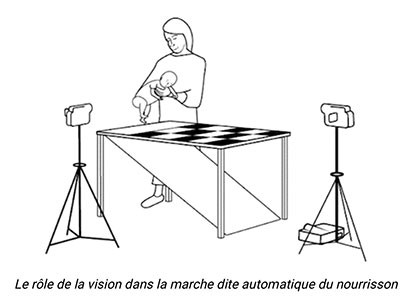
What is observed in this situation is not automatic bipedalism, but a form of quadrupedal locomotion, where the arms and legs activate together, in response to the optic flow.
👉 These observations show thathuman walking is not the continuation of an archaic automatism, but indeed a neuromotor constructionguided by perception, tonic adjustment, and sensory interactions.
In other words, postural tone, gaze, movement, and intention are intimately linked from the first weeks of life —it is not the body that acts by reflex,it isthe brain in connection with the environmentthat builds movement.
🔍 These results invalidate the idea of a universal “reflex walk” and highlight how much the emergence ofbipedal posture in humans is a dynamic, multisensory, and deeply embodied construction.
Archaic reflexes: signals, not causes
The temptation is great, when a child has motor or behavioural disorders, to rely on a reassuring explanation: "they have not integrated their primitive reflexes".
It is simple. It can be corrected. And it gives an illusion of a quick solution.
But reality is often more complex, more subtle, and deeper.
Archaic reflexes are messengers, witnesses of a still immature tonic regulation.
They are not the primary cause, but the visible expression of an imbalance that taking root long before birth: in breathing, posture, balance, overall tonic alignment.
Breath and verticality as pillars of development
What we call, at the Neurosens Institute, the Tonic-Ventilatory System (TVS) constitutes the foundation of a stable, breathed, living posture.
This system integrates:
the coordination of the diaphragm with the upper airways via the dilator muscles of the pharynx and tongue
deep postural muscles and abdominal-pelvic muscles
vestibular pathways,
and all the proprioceptive and exteroceptive sensory circuits that allow the child to constantly calibrate their inner compass to stand, act, and think.
It is onto this living tonic-postural framework that attention, emotional regulation, and cognition graft themselves.
Towards another reading of neurodevelopmental disorders
A French discipline born from a psychoanalytic heritage: psychomotricity
The profession of psychomotor therapist, specifically recognised in France since the 1970s, was born from the joint influence of psychoanalysis and psychocorporeal pedagogy. Although it has integrated contributions from sensorimotor functioning especially inspired by Jean Piaget, it has remained marked by a mind-body dualist conception, influenced by the great figures of psychoanalysis.
In this context, the body was not always approached as a living system subject to the laws of neurophysiology. The study of tone, though fundamental in the work of researchers like Pierre-Paul Vidal, Alain Berthoz, or indeed Jacques Paillard (CNRS Marseille), has long remained marginal in the initial training of psychomotor therapists.
This partly explains why French psychomotricity could ignore — or relegate to the background — the question of human bipedalism and its neuro-mechanical complexity. Yet this characteristic places us, as a species, at the peak of a demanding evolutionary programme, of which a fine understanding is essential to support children in their development.
More recently, faced with the rise of approaches centred on archaic reflexes, some psychomotor therapists have denounced, not without reason, the sometimes hazardous practices of people intervening without training or a legal framework. A decree of 10 August 2021 (No. 2021-1131) relating to the use of the title of psychomotor therapist came to recall the limits of practice of certain so-called “ reflex ” approaches.
But this reaction, although useful for protecting children, cannot elude introspection: psychomotricity itself was sometimes slow to integrate the advances of modern neurophysiology.
Fragmentation of practices, fragmentation of knowledge
The history of these disciplines — whether psychomotricity, occupational therapy, speech therapy, or indeed reflex methods — shows just how much child care professions have often been structured not from a unified life science, but according to ideological, philosophical, or psychological currents of thought.
This plurality and specialisation of knowledge has sometimes led to approaches that are not always fully connected to each other, which can reduce their coherence with the fundamental principles of sensorimotor development.
One of the objectives of integrative neurotherapy is precisely to rebuild these bridges, to unify approaches around what developmental biology, tone physiology, and regulation sciences teach us today.
Thus, this article is also intended as an invitation: to revisit our professional foundations, to shed light on the roots of our practices, and to rethink child support from a truly integrative perspective that respects their living nature.
Rather than seeing ADHD, dyspraxia, or behavioural disorders as "brain disorders", we propose reading them in the light of the body:
What if these disorders were the consequences of a tonic-postural imbalance rooted in an unintegrated bodily history?
This does not call into question the reality of the disorder, but opens a complementary therapeutic path, more global and meaningful.
From reflex to posture: history of a bodily misunderstanding
From pedagogical reflexology to embodied neurotherapy: finding balance
1. A forgotten bodily genealogy: between Cold War, scientific isolation, and search for solutions
Methods centred on archaic reflexes did not emerge from a vacuum. They were born from a very specific historical, political, and cultural context: that of the second half of the 20th century, marked by the Cold War, the East-West division, and the difficulty of accessing recent scientific discoveries, notably in developmental neurosciences.
In Eastern Bloc countries, deprived of Western technological tools (neuroimaging, advanced electrophysiology), clinicians developed empirical bodily approaches, based on the observation of reflexes, postural tone, and motor chains. In their own way, these approaches reasserted the place of the body in child development, against a strictly brain-centred vision.
This is how there appeared:
the Vojta method (1950s–60s), in Czechoslovakia, aiming to activate reflex motor chains via specific pressures;
the Bobath concept, spread in the 1960s–70s to work on the motor skills of children with cerebral palsy, still widely used today;
PNF (Kabat), adopted in a simplified version in some Eastern European countries ;
the Masgutova Method (MNRI®), in the 1980s–90s, which formalises the systematic stimulation of primitive reflexes.
Abreast of this, in Brazil, Beatriz Padovan, a speech therapist, developed an approach inspired by motor development sequences, in connection with Rudolf Steiner's anthroposophy. Her method, known as neurofunctional reorganisation, integrates archaic movements in the treatment of language and cognitive disorders. Her daughter, Sonia Padovan, continues its dissemination today in several countries.
In the West, it was in the United Kingdom that Peter Blythe founded the INPP (Institute for Neuro-Physiological Psychology) in the 1970s, continued by Sally Goddard Blythe, who contributed to widely spreading the idea that persistent reflexes would be at the origin of learning difficulties. This line of thought was introduced in France in the 2000s by Harald Blomberg: BRMT (Blomberg Rhythmic Movement Training, then consolidated by Paul Landon from 2003.
Finally, in the United States, Paul Dennison created Brain Gym® in the 1980s. This approach, often simplified, is based on the idea that certain bodily gestures “activate” the brain hemispheres.
All these movements sought to help the child in difficulty, by mobilising the bodily resources at their disposal. They met a fundamental human need, long before the rise of neurosciences, psychophysiology, and evidence-based approaches.
But their disciplinary isolation, in a context of compartmentalisation of knowledge, sometimes led to freezing valuable intuitions into dogma, without them being able to be confronted with integrated neurophysiological models.
2. What these approaches enabled… and what they forgot
The merit of these approaches is undeniable: they re-integrated the body into clinical development, where psychiatric and cognitive models had focused everything on the brain, behaviours, or visible symptoms.
They enabled:
looking at the child in their primitive motor skills,
observing what they did not yet express through language,
proposing accessible interventions without technology.
👉 They thus crystallised fragile hypotheses into causal certainties, according to a simplifying logic:
“If an archaic reflex persists, then it is the cause of the disorder. It must be inhibited to free function.”
This premise, attractive in its simplicity, is insufficient. It omits major dimensions of development:
brain plasticity and reorganisation through experience,
breathing as a regulator of tone,
overall tonic-postural coordination,
the role of emotional attachment, proprioception, vestibular system,
the synchronisation of tone–perception–emotion.
It reduces development to a linear mechanical reflex → inhibition → improvement, without taking into account u0001the non-linear dynamic complexity of the living.
3. Finding balance: from reflex towards living posture
What integrative neurotherapy proposes today is not a rejection, but a systemic review of these approaches.
The archaic reflex is not denied. It is recognised as an indicator, a signal, a witness of a tonic immaturity, of a disorganisation of the experienced body, but not as an independent cause.
👉 What matters is not the inhibition of a reflex. It is the restoration of a living posture, carried by breath, anchored in balance, sustained by the sensory and emotional bond.
At the heart of this posture lies the Tonic-Ventilatory System (TVS):
coordination of the diaphragm, deep postural muscles, and vestibular chains,
regulation of tone through breathing,
anchoring in space, in gravity, in relation.
The TVS acts as a silent conductor of verticality, movement, emotional regulation, and attention.
It is this system that must be restored before acting on isolated reflex expressions.
Towards a living science of self-regulation: an expected convergence
Today, we are witnessing a fruitful reunification between neurophysiology and psychology, thanks to two major levers:
Measurement tools from psychophysiology, which make internal processes visible: heart rate variability, brain rhythms, muscle tone, respiratory regulation, etc.
The rediscovery of clinical observation and relational listening in a systemic, non-linear logic that respects the complexity of the living.
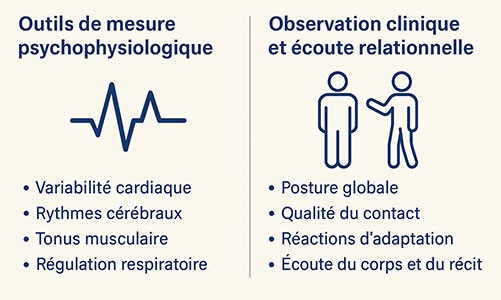
This encounter betweenmeasurable scienceandembodied experienceopens the way to a new approach:
👉 An education in self-regulation, based on active learning, breathing, living posture, and the reintegration of the mind-body connection.
It is no longer a top-down therapy. It is no longer an imposed protocol.
It is a pedagogy of self, supported by science, but inspired by the living.
This is what integrative neurotherapy supports.
Understanding postural tone – the forgotten starting point
Postural tone is not a muscle, nor a straight posture, nor a reflex to be corrected.
It is the internal and dynamic organisation of the body that allows the child to stand, orient their attention, breathe, feel, and think.
This tone is in direct connection with:
gravity: how the body manages balance and rising up;
breathing: how the breath modulates deep tone;
sensory inputs: proprioception, vestibular system, skin;
and the relationship: inner security, co-regulation with others.
👉 When it is unstable, everything falters: attention, emotions, behaviour, sleep, learning.
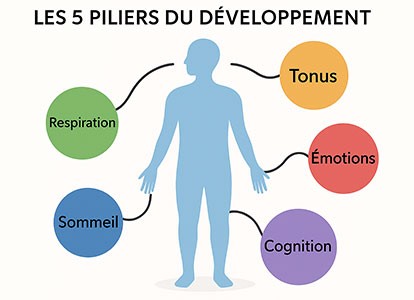
This is whypostural tone is the first pillarof integrative neurotherapy:
not because it is visible, but because it isthe invisible frameworkon which all others rely.
Conclusion: an critical integration for a new paradigm
The reflexological approaches of the 20th century were necessary, bold, profound, and sometimes even pioneering. But their isolation, simplification, and dogmatic drift impose on us today a duty of critical integration.
We can no longer consider a child as a accumulation of reflexes to be inhibited. We must support them in the reconstruction of a living body, breathing, feeling, balancing in space and relationships.
This return to balance between posture, breath, movement, and connection is what we support with integrative neurotherapy.
📚 A necessary reconstruction of the link between life sciences and support professions
What we have tried to show in this article is to what extent postural tone constitutes an essential reading key, at the crossroads of neurophysiology, developmental clinical practice, and the history of educational or therapeutic practices.
But it is not enough to declare a "global" approach: we must still understand why current professional practices are often fragmented, torn between ideological models and clinical intuitions.
Towards an integrative map of bodily approaches
For more than 50 years, empirical methods have flourished worldwide to help children with developmental disorders: integration of archaic reflexes, motor education, sensory or postural approaches… Each has brought its share of truth, intuition, and local efficacy. But no scientific mapping connects them to each other, and few of them dialogue with current knowledge in neurophysiology.
👉 This fragmentation is both a wealth and a weakness.
Throughout our practice — by crossing our paths, our research, and our joint experiments with Guylaine Bédard and the Neurosens Institute team — we have come across many of these methods. This journey has taught us their value, but also their limits. Above all, it has led us to recognise the underlying systemic complexity, which goes far beyond reading grids focused on reflexes.
This is precisely where the vocation of integrative neurotherapy lies: not to reinvent everything, but to connect, articulate, reorder. To offer a clear, living, and rigorous framework to what was, until now, isolated pathways. It is in this crossroads between the history of practices, neuroscientific data, and embodied clinical intuition, that we propose today a new ecology of care.
Fortunately, researchers in major laboratories of the CNRS, INSERM, or AP-HP, often far from professional turf wars, have continued to deepen the fundamental laws of bodily and tonic development. Among them, Antoine Remond, a pioneer of French electrophysiology and member of the AAPB since its foundation in 1969, made it possible to link European and North American work in psychophysiology.
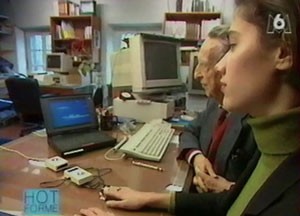
Caption :Antoine Rémond during a Biofeedback session
Today, integrative neurotherapy is part of this lineage: that of a living body, carrier of rhythms, adjustments, fine regulations, and not a pile of symptoms or isolated reflexes.
We invite young practitioners to explore the history of their discipline, to recognise its foundations, its contributions, and its still unexplored areas. It is in this deep understanding that an embodied paradigm of care and education can emerge.


