Adult ADHD: what if the real problem wasn't attention... but recovery?

In adults with ADHD, difficulties with attention are often brought to the forefront.
Organisation, concentration, impulsivity: everything seems to point back to the brain and its cognitive functions.
But another reading is beginning to emerge.
More and more data suggests that the quality of physiological recovery — particularly during sleep — could directly influence the intensity of attentional symptoms.
What if adult ADHD were not just an attention disorder…
but an inability of the nervous system to oscillate between activation and recovery?
1 — The brain: that organ we think we understand
2 — Health: the ability to return
3 — Adult ADHD: what if the real problem were not attention… but recovery?
Listen to the audio version of this article
You hold on. But you do not recover.
You perform.
You meet demands.
You handle emergencies.
You deliver on time.
People describe you as fast.
Creative.
Responsive.
And yet, every evening, something cracks.
You hold on.
But you do not recover.
The day ends, but the brain stays switched on.
The body lies down, but the tension never really drops.
Sleep comes… without restoring.
The next day, you start again.
Still capable.
But a little more worn down.
People talk to you about attention deficit.
People talk to you about organisation.
People talk to you about discipline.
But what if the question lay elsewhere?
Adult ADHD is perhaps not a lack of energy.
It is perhaps an energy that no longer knows how to settle down.
The paradox
Many adults with ADHD are capable of:
– intense mental hyperactivation
- creativity under pressure
- efficiency in emergency mode
- professional hyperinvestment
The system activates powerfully.
But it struggles to return to a state of calm.
Yet every living organism functions on a fundamental principle:
it oscillates.
Activation → recovery → stabilisation.
When recovery becomes incomplete,
the adaptive margin decreases.
And symptoms become more visible.
Fundamental — Recovery is not rest
Recovery is not a simple cessation of activity.
It is an active physiological process.
After an activation phase (concentration, alertness, stress),
the nervous system must be able to return to its baseline state.
This return involves:
– autonomic slowing
- respiratory modulation
- access to deep sleep
- synchronisation of biological rhythms
A healthy system oscillates.
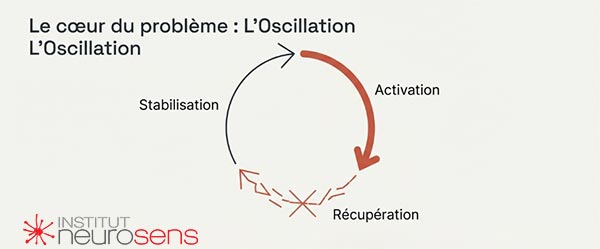
In many adults with ADHD, activation is effective.
But the return is incomplete.
The problem is not intensity.
It is the oscillation.
What scientific data shows
Research on adult ADHD consistently highlights several findings:
– high prevalence of sleep disorders
- altered heart rate variability
- persistent evening cortical hyperactivation
- difficulty accessing intermediate states of relaxation
These disruptions are not simply uncomfortable.
They are associated with:
– increased attentional variability
- heightened inhibition difficulties
- more unstable emotional regulation
- persistent daytime fatigue
Altered sleep does not merely coexist with ADHD.
It modulates its expression.
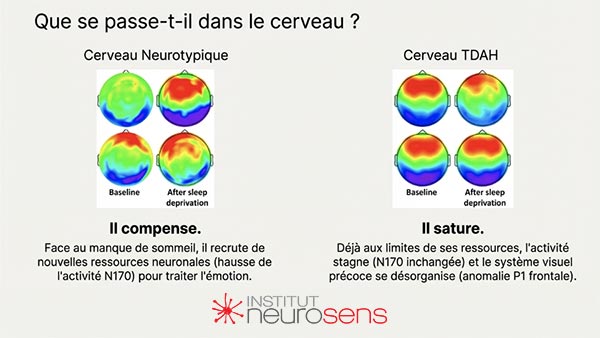
A study published in 2026 in Scientific Reports shows that sleep deprivation alters early event-related potentials involved in emotional processing in adults with ADHD, objectifying a measurable modification in cortical dynamics (Dan et al., 2026).
Concretely, this means that sleep deprivation does not just modify the general state of fatigue.
It transforms how the brain processes information from the very first stages of perception.
In other words, sleep regulation directly influences the dynamics of cortical processing.
In this perspective, the attentional fluctuations observed in adults with ADHD could be linked, at least in part, to an alteration in this capacity for physiological recovery.
In other words:
recovery directly influences the intensity of symptoms.
Beyond symptoms, recovery relies on a more fundamental phenomenon: the synchronisation of the body's slow rhythms.
Deep sleep, slow breathing, heart rate variability, postural micro-oscillations at equilibrium, and certain low-frequency brain oscillations contribute to a common dynamic of multi-systemic regulation.
This coordination is not a coincidence. It follows a physiological organisation that can be described.
— Clinical Alert
A marker of regulation is not regulation itself
In a systemic reading of adult ADHD, it would be reductive to confuse heart rate variability with physiological recovery as a whole.
HRV is a valuable indicator of autonomic flexibility, but on its own, it does not suffice to account for the overall state of the system.
When a Tonic-Ventilatory System (TVS) is desynchronised, the difficulty never concerns a single isolated parameter. It involves at least an interaction between muscle tone, ventilation-respiration, sleep and, consequently, cortical arousal and cognition.
In this context, using HRV or cardiac coherence as the sole lever of intervention can help modulate the system's state without resolving the root cause of the disorganisation.
An apparent improvement in an autonomic marker can sometimes be observed, even while there persist:
inefficient or compensated ventilation,
unidentified upper airway resistance,
background tonic tension,
fragmented or poorly restoring sleep,
instability of cortical arousal.
A better HRV score does not, therefore, on its own, prove that real physiological recovery is restored.
In the approach of integrative neurotherapy, the question is not only:
“does the system seem calmer ?”
but rather:
“has the system really retuned itself in the coordination of its fundamental pillars?”
Fundamental — The Tonic-Ventilatory System (TVS)
The body’s slow rhythms do not function in isolation.
Breathing influences heart rate variability.
Heart rate variability modulates attentional stability.
Postural tone constantly adjusts balance and cortical arousal.
Low-frequency brain oscillations reflect these overall dynamics.
The Tonic-Ventilatory System (TVS) refers to this coordination between tone, ventilation, and autonomic regulation.
It is not an organ.
But an integrative dynamic.
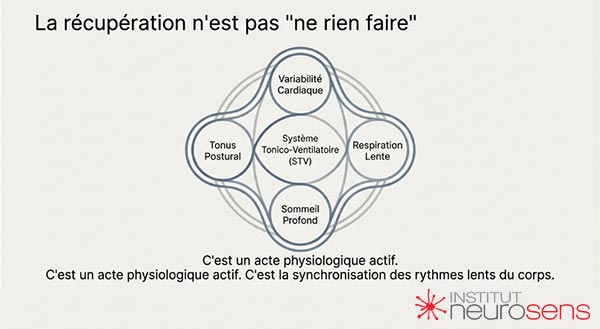
In this perspective, measuring respiration, heart rate variability, muscle tone, or brain activity separately is like looking through different windows at the same system.
Understanding their synchronisation allows us to move beyond a compartmentalised view of physiology.
When these parameters are observed together, a more coherent reading of recovery becomes possible.
Understanding this dynamic forces us to revisit the way we classify symptoms.
A shift in perspective — What if comorbidity were just an effect of language?
In the literature, sleep disorders are often described as a comorbidity of adult ADHD.
The term is useful.
It allows for classification.
But living organisms rarely function in watertight compartments.
When sleep influences attention,
attention modifies emotional regulation,
emotions disrupt falling asleep,
and breathing modulates cortical activation…
Are we still dealing with associated disorders?
Or with a system that is constantly interacting?
Circular causality does not deny symptoms.
It connects them.
The question is no longer:
Which disorder is primary?
But:
Which pillar is temporarily the most unstable?
The example of Marc
Marc is 38 years old.
Senior executive. Diagnosed with ADHD at 35.
Brilliant. Fast. Creative.
At 10 pm, he is still in front of his screen.
His brain is producing ideas as if it were 10 am.
He goes to bed late.
Wakes up tired.
Functions in energy spikes.
Collapses at the end of the day.
He says:
“I manage stress. What exhausts me is never recovering.”
The physiological assessment shows:
– low heart rate variability at rest
- slow recovery after cognitive stress
- difficulty returning to baseline
Nothing alarming.
But a reduced adaptive margin.
By working on breathing regulation and rhythm stability:
– sleep status improves
- attention becomes more stable
- irritability decreases
Marc has not “lost his ADHD”.
He has recovered a smoother oscillation.
By recovering more effective physiological recovery, the system regains its variability.
And with it, its capacity for oscillation.
Adult ADHD is not just an attention disorder.
It is also a disorder of physiological oscillation.
The real shift
Perhaps adult ADHD is not first and foremost an attention deficit.
Perhaps it is a difficulty in recovering.
A system that activates powerfully but does not quieten down progressively loses its variability.
Yet variability is the signature of the living.
Without it, fine adaptation is no longer possible.
Attention fluctuates.
Inhibition weakens.
Emotion overflows.
Fatigue sets in.
Not through a lack of will.
But through an alteration of the oscillation.
Recovery is not an abstract concept.
It is an objectifiable physiological dynamic.
It can be read in heart rate variability.
In respiratory regularity.
In the depth of slow-wave sleep.
In postural stability.
In the modulation of brain rhythms.
When these parameters desynchronise, the system remains in background tension.
When their coherence is restored, attention stabilises without excessive effort.
The question is perhaps no longer:
How to strengthen concentration?
But:
Does the system still know how to slow down?
This is where a central concept appears: the adaptive margin.
In other words, the system's capacity to absorb an activation load without exhausting itself.
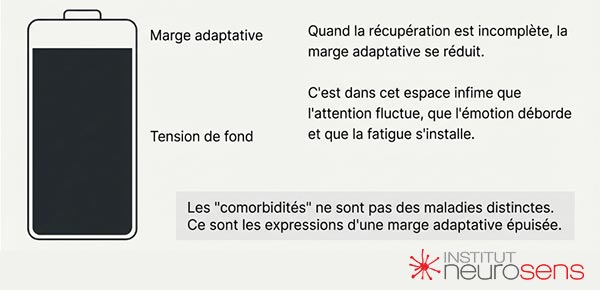
When recovery is effective, this margin is wide.
When recovery becomes incomplete, it shrinks.
And the more it shrinks, the more visible symptoms become.
Understanding the adult with ADHD through this dynamic physiology changes the perspective.
Attention, sleep, respiration, postural tone, and emotional regulation are not compartments.
They are the different expressions of the same balance.
Before correcting symptoms,
we sometimes need to restore the capacity to recover.
And what can be measured can become modulable.
In a future article, we will look at how to objectify this adaptive margin in adults — and above all how to restore the variability that allows the system to regain its capacity for oscillation.
What this trilogy teaches us
Over several articles, we have explored a simple but profound idea:
the brain cannot be understood independently of the living system that supports it.
We have seen that health does not correspond to rigid stability, but to the system's capacity to oscillate between activation and recovery.
In this perspective, the attentional fluctuations observed in adults with ADHD could be linked not only to executive functions, but also to the capacity of the physiological system to recover.
These three articles therefore present a shift in perspective:
– the brain functions within a living organism
- health relies on physiological variability
- recovery conditions the stability of attention.
In future episodes, we will see how these mechanisms express themselves through the five pillars of physiological regulation and how they can become modulable.


